
Research Center for Group Dynamics launching new initiative
October 29, 2026
When the Research Center for Group Dynamics (RCGD) was founded at MIT in 1945, its core mission was to ensure that technology advanced in ways that informed and accounted for human dynamics and interests. In the age of artificial intelligence, that mission is as important today as it was in the wake of World War II.
Shinobu Kitayama, newly appointed RCGD director and the Robert B. Zajonc Collegiate Professor of Psychology in LSA, has announced a new initiative to continue traditions set by RCGD predecessors while leading the center into new frontiers, with a particular focus on applications of advanced technologies in the social sciences.
The initiative will be directed by Amie Gordon, associate professor of psychology in LSA and a faculty associate in RCGD, which is one of the five centers that make up the Institute for Social Research.
“The study of group dynamics began with small groups, but the fundamental questions that inspired Kurt Lewin and the founders of RCGD remain as important as ever,” Kitayama said. “Today, advances in computational methods, network science, artificial intelligence, and neuroscience, combined with population-level data collection, allow us to investigate these same questions at the scale of communities, institutions, societies, and cultures.”
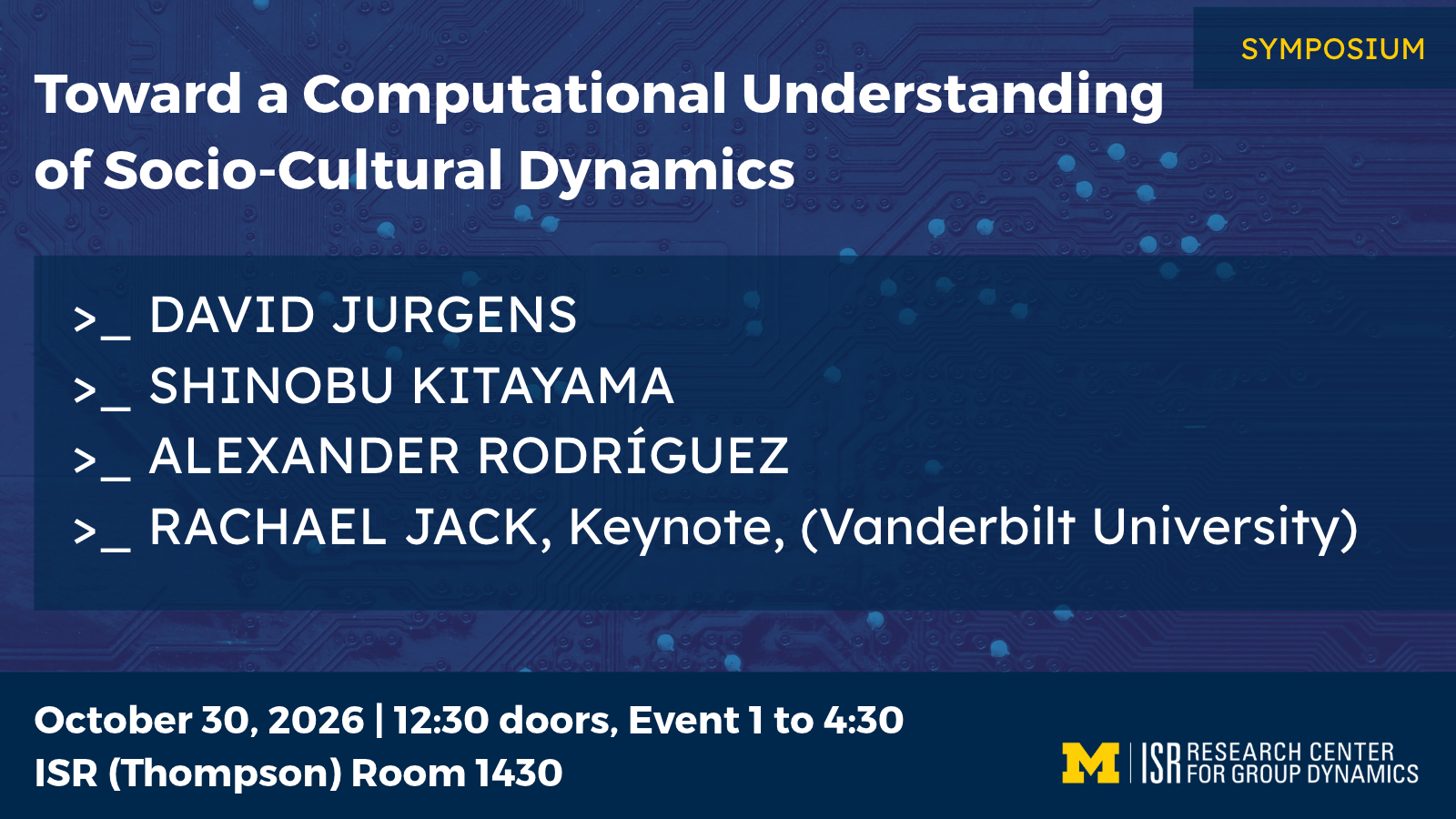
To launch the initiative, RCGD is hosting a symposium Oct. 30, “Toward a Computational Understanding of Socio-Cultural Dynamics,” that will allow scholars from many disciplines to come together to understand the dynamic social and cultural processes that shape human behavior and flourishing. The event will be followed by an RCGD winter speaker series on the same topic to stimulate further conversations around computational methods in social science.
“The symposium brings social scientists and computational scientists together for an afternoon to promote interdisciplinary work on sociocultural dynamics,” said Gordon, who as an example of how center scientists are applying novel methods to unlock new insights co-created the U-M dating app, Revel, to gather data on how romantic relationships form, last and dissolve. “RCGD will be a hub for faculty and students across disciplines to open new avenues for collaboration.”
The symposium features a keynote lecture by Rachael Jack of Vanderbilt University, “Cracking the Code of Human Social Communication: A Computational Approach,” along with a series of flash talks by University of Michigan experts (Professor David Jurgens of the School of Information and the Department of Computer Sciences, and Assistant Professor of Computer Science and Engineering Alexander Rodriguez, and Kitayama) to introduce non-computational scientists to methods relevant to the study of complex social and cultural processes.
RCGD is known for conducting foundational social science with innovative, real-world research applications. It has been an incubator for major ideas in social psychology — including behavior change, cognitive dissonance, and network analysis — while advancing a broad array of scholarship across cultural psychology, evolutionary anthropology, political psychology, stereotyping and social judgment, communication, climate change, health disparities, violence and aggression, and systemic racism.
This post was written by Tevah Platt, communications manager for the Research Center for Group Dynamics.