
University of Michigan Researchers Use Virtual Reality to Help Piano Students Conquer Stage Fright
August 18, 2026
Piano Lab Pro premieres August 27 at the School of Music, Theatre & Dance
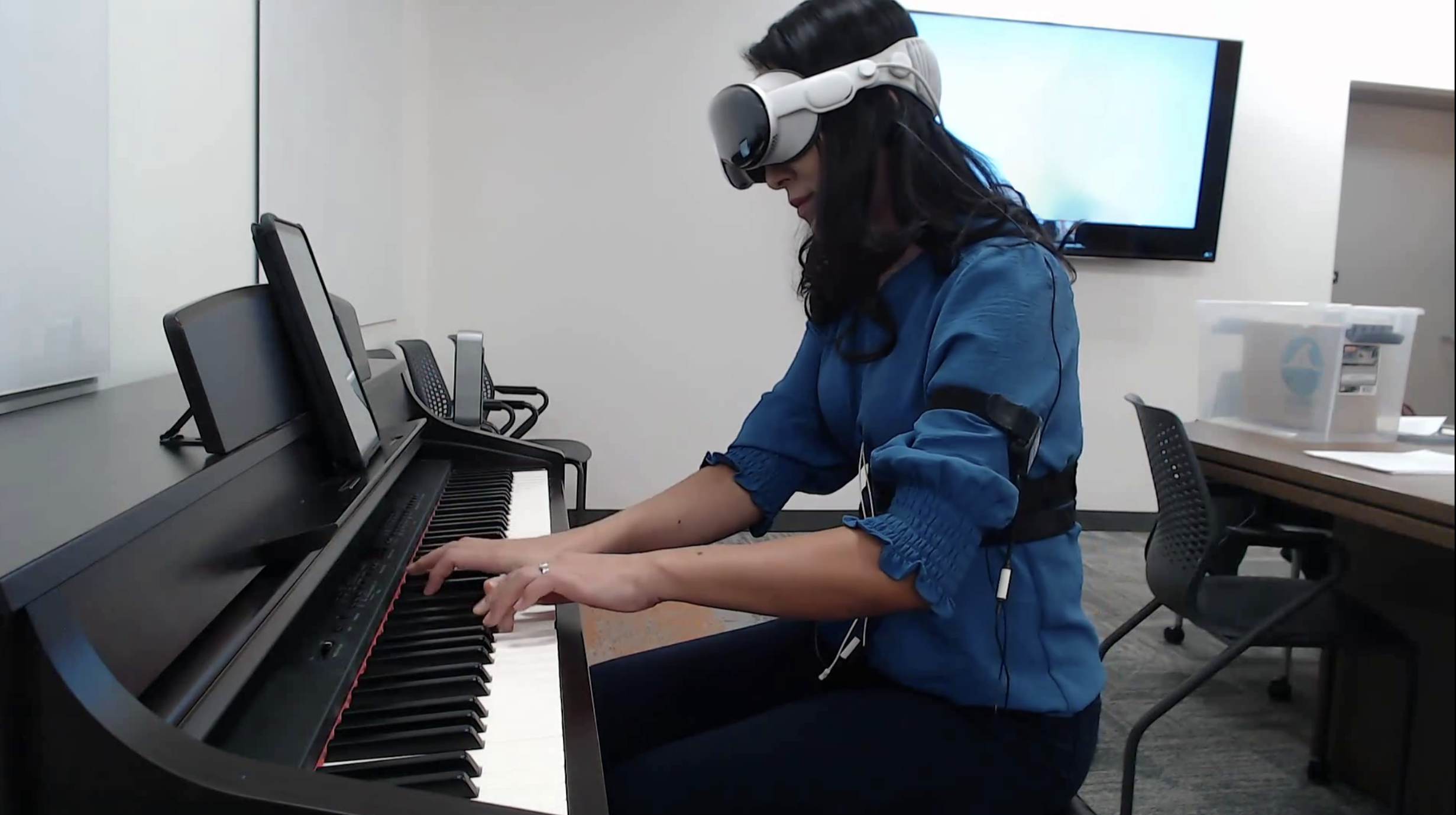
ANN ARBOR, Mich. — Can performing music in a virtual setting—complete with a stage, a spotlight, and a shuffling crowd—help performers learn to cope with stage fright? A collaborative team at the University of Michigan is putting that question to the test with Piano Lab Pro, an immersive extended-reality (XR) tool that will premiere at a live event on August 27.
A Cross-Campus Collaboration
Piano Lab Pro brings together expertise from across the university. Aga Higuchi Hagelthorn, lecturer of piano pedagogy and Director of Collegiate Class Piano and Coordinator of the Piano Pedagogy Laboratory Program, received a project grant from U-M’s Center for Academic Innovation (CAI) to collaborate with the center’s XR team. Together, they set out to develop an immersive performance environment for piano students using the Apple Vision Pro, exploring the potential of extended reality in music education.
To measure how the virtual environment affects performing musicians, Hagelthorn partnered with the Biosocial Methods Collaborative at the Institute for Social Research (ISR). Home to campus resources including the U-M Homelab and the Biosocial Methods Collaborative, ISR’s Research Center for Group Dynamics is known for applying observational tools to study human subjects in real-life or simulated contexts built for solving real-world problems.
Rich Gonzalez and the Biosocial Methods group designed the pilot phase of the Piano Lab project, developing the surveys, interviews, and lab protocol, and contributing psychophysiological measurement of anxiety’s impact using Piano Lab Pro.
Measuring Anxiety, Down to the Pores
Using biological sensors and surveys, the Biosocial Methods team developed a protocol to identify when anxiety set in and how it affected performers.
“The cleanest signal of the activation response turned out to be sweat, which we measured from the feet,” said Alicia Carmichael, research process director at Biosocial Methods. “When the musicians got nervous, we could detect minor fluctuations indicating the fight-or-flight response had been activated.”
Reflections gathered from performers during the pilot helped the team evaluate how the stress response affects musicians, whose performances can be wrecked—or boosted—by nerves.
The Premiere Event
A live event hosted by the U-M School of Music, Theatre & Dance (SMTD) will serve as the premiere of Piano Lab Pro, which enters Hagelthorn’s piano curriculum in September. The program includes a live demonstration, a look at the biofeedback research behind the tool, and remarks from SMTD Dean David Gier, ISR Director Kate Cagney, and CAI Chief Technology Officer Jeremy Nelson.
All Musicians Invited to Participate
Following the presentation, Biosocial Methods will host a brief focus group open to any adult musicians—including vocalists—to discuss performance anxiety and its impact.
In the coming year, Biosocial Methods will continue evaluating the application’s effectiveness for improving stage presence, supported by a new Arts Initiative grant that will test the app with a larger cohort of participants.
The project adds to a body of U-M work that applies social science research to challenging questions in the arts. Researchers from SMTD, ISR, and the University Musical Society (UMS) have been collaborating with the Berlin Philharmonic Orchestra to study how the ensemble sustains its high levels of performance, artistry, and cultural leadership. That effort is supported by a three-year Projects in Partnership sponsorship from the U-M Arts Initiative.
Event Details
What: Piano Lab Pro premiere and performance-anxiety focus group
When: Wednesday, August 27, 1:30–3:30 p.m.
Where: Britton Recital Hall, Earl V. Moore Building, 1100 Baits Dr., Ann Arbor
Cost: Free; registration required to attend and to participate in the focus group