
Convoys of Caregiving: Arab American Families Living with Dementia
April 8, 2026
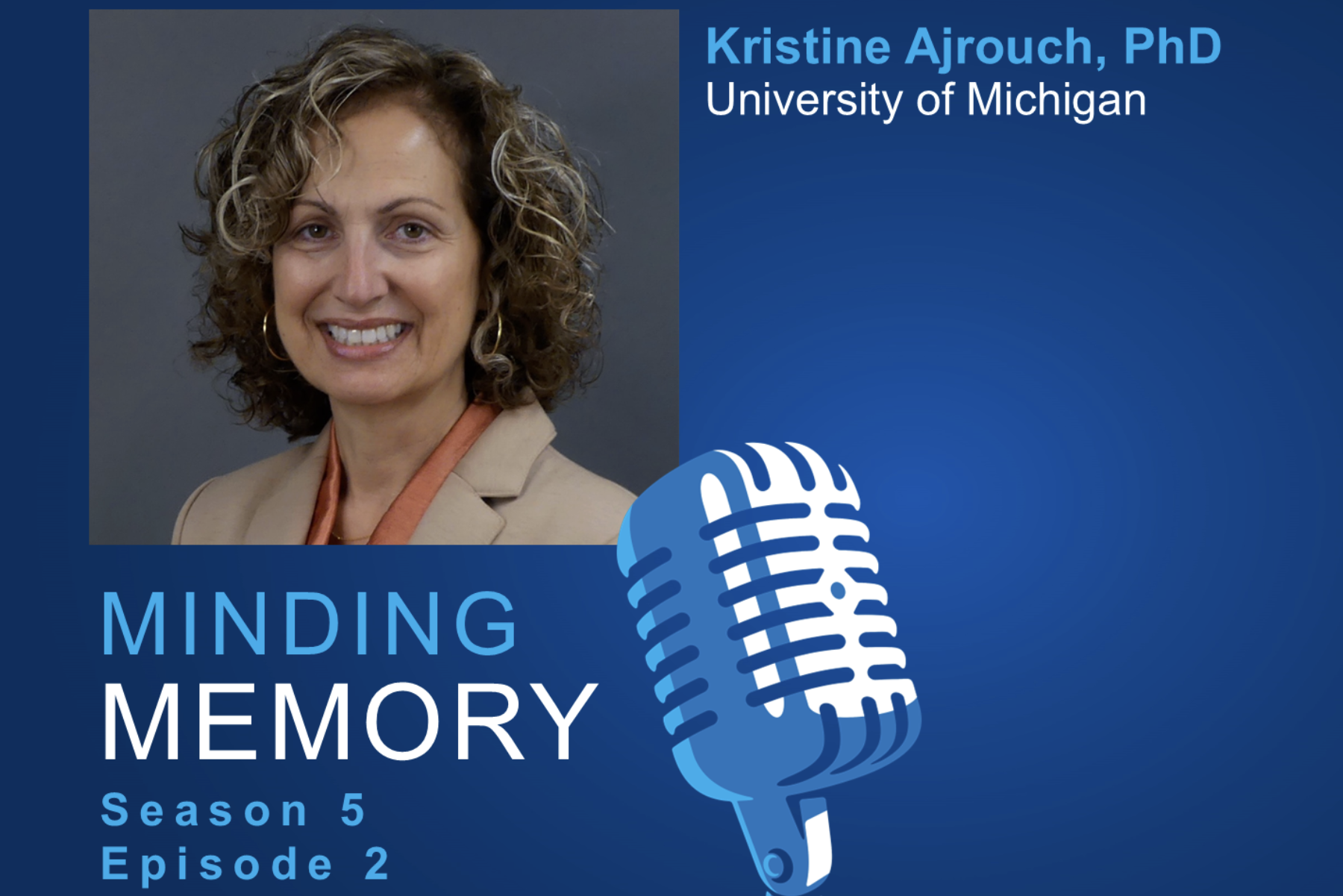
Listen to the Michigan Medicine podcast, Minding Memory, interview with Kristine Ajrouch, PhD
In this episode, Matt & Lauren speak with Kristine Ajrouch, PhD – a new member of our CAPRA leadership team. Kristine is a Research Professor at the Institute for Social Research whose work focuses on aging, health, immigration and family in the United Statues and the Middle East; social networks over the life course; and Arab American identity and well-being.
Kristine discusses a recent article that examined an intervention to improve outcomes among Arab American caregivers who provide care to a family member living with dementia. She also shares what this work teaches us about caregiving as a family system rather than the responsibility of a single individual.
More resources
Kristine Ajrouch Faculty Profile
Article referenced in podcast:
Ajrouch KJ, Barada FM, Janevic MR, Antonucci TC. Supporting Arab-American Families Living With Dementia: Testing a Culturally Adapted Program. J Appl Gerontol. 2025 Apr;44(4):515-519. doi: 10.1177/07334648241281153. Epub 2024 Sep 23. PMID: 39313309.
Transcript
Matt Davis:
Older Arab Americans are a rapidly growing population in the United States that often experience limited access to social services due to language and cultural barriers. These issues can greatly magnify the demands of providing care to a loved one with dementia and manifest in a belief that family alone is the only option. In this episode, we’ll discuss a recent article that examined an intervention to improve outcomes among Arab American caregivers who provide care to a family member living with dementia. And also, we’ll explore what this work teaches us about caregiving as a family system rather than the responsibility of a single individual.
Welcome to Minding Memory, a podcast devoted to exploring research on Alzheimer’s disease and other related dementias. Here, we’ll discuss some of the most compelling research and talk with leaders in the field about how their work is improving the detection and treatment of dementia. I’m Matt Davis.
Lauren Gerlach:
And I’m Lauren Gerlach.
Matt Davis:
We’re both researchers at the University of Michigan. I have a PhD in data science.
Lauren Gerlach:
And I’m a geriatric psychiatrist who specializes in diagnosis and management of dementia.
Matt Davis:
I’ll work to minimize the use of medical jargon in our discussions.
Lauren Gerlach:
And I’ll make sure that the research we talk about has practical real-world applications to people living with dementia and their care partners.
Matt Davis:
Thanks for joining us, and let’s get started.
We’re joined today by Dr. Kristine Ajrouch. Dr. Ajrouch is a research professor at the Research Center for Group Dynamics at the University of Michigan’s Institute for Social Research. Her research focuses on aging and health, social networks over the life course, and the health of Arab Americans. She’s also recently joined the leadership team of CAPRA. She’s here today to speak with us about her recent study. Kristine, welcome to the podcast.
Kristine Ajrouch:
Thank you. It’s a pleasure to be here.
Matt Davis:
Dr. Ajrouch was the lead author of the study titled Supporting Arab American Families Living with Dementia: Testing a Culturally Adapted Program, that was published in the Journal of Applied Gerontology. A link to the article can be found attached to this episode. Make sure to check it out. So to start things off, welcome to the CAPRA community. We’re thrilled to have you join the leadership team. I was wondering if you could just tell us a little about yourself and your research interests.
Kristine Ajrouch:
Well, first, let me just say what a delight it is to join the CAPRA team. I’m really enjoying my time with the group. And in terms of a little bit about myself, so I am trained as a sociologist. My pathway to sociology was kind of long and winding. I started off as a business major and realized I didn’t want to do that as an undergrad and then went into communications as a master’s program where I really got interested in cultural issues and learned that communication studies was an offshoot of sociology. So then I got to sociology, which is what I did my PhD in. And I got very interested in culture as an important system for understanding not just what’s happening within a group, but to really understand what’s happening between groups. And then that brings me to gerontology where I did my postdoc and I came to realize that you can’t really be a good sociologist unless you really take into account life course issues.
And you can’t take into account life course issues unless you have a real focus on the latter part of the life course in addition to the earlier stages. So that’s kind of a little bit about my background and how I got to where I am. The postdoc in aging is really what, I guess, excited me about research more than anything else. I learned the importance of understanding perspectives from various points in the life course, but also from various groups and from various cultural vantage points. And then got interested in Alzheimer’s and related dementias from a social and behavioral aspect because I recognized it was growing as a concern in society in general. And I also had some family experiences with it as well. And specifically my father-in-law who had Alzheimer’s, he was an immigrant from Lebanon.
And I realized that the understanding of the disease from the perspective of Arab Americans was pretty limited in terms of the community. In terms of my family specifically, but in the community in general. And I realized that we just needed more work to really understand the issue for not just this community, but I think from a social and cultural perspective. Because as I started to do more reading and sort of digging into what existed in terms of the research, I realized we still had a lot to learn, especially when it comes to groups who are underrepresented in research studies.
Matt Davis:
It’s interesting, the personal connection. I don’t know. It’s just interesting how people do have some connections to what they do in terms of research and it’s easy to forget that. So on a personal note though, Lauren and I have been experimenting with this “fast friends survey” in terms of getting to know our new colleagues here on the leadership team. Do you want to try doing a fast friends question? Should we do this, Lauren? Okay. I’m going to pick a question and we can all answer just to get to know each other a little better. So here’s a question. If you could wake up tomorrow having gained any one quality or ability, what would it be?
Kristine Ajrouch:
One of the things that I’d like to do is really be able to learn how to see the light in the darkness that sometimes we experience around us. Not just on a personal level, I think on a societal level, trying to see the light as a way to move forward and do things that are positive. There’s a great quote and I can’t remember. I can’t remember what it… Oh, I think it comes from the poet, Amanda Gorman, at the end of her poem that she said when Joe Biden was inaugurated as president, where she talked about… At the very ending statement was something about if only she could see the light, if only she could be the light. And I oftentimes think about that because I just think that there’s so many challenges in the world today. And being able to find ways to see optimism and to see a way forward and to see the light, that’s kind of one of the things that I’d like to be able to do. I guess, if I woke up and was able to do that, it would be great.
Matt Davis:
It’s really nice. I feel really superficial with my answer. I was just going to say to be able to fly. What about you, Lauren?
Lauren Gerlach:
Both are simultaneously beneficial. No, that was beautiful and I think so ever increasingly important. Not nearly as eloquent. I don’t know. I think just the ability to kind of fully unplug and be present. So I think my brain and kind of the forward movement, things are always jumping ahead to the next task. And I think the ability to just have sustained kind of presence, kind of mindfulness to be in the moment. So that’s something I try to do, but it’s tough with everything going on. And so if I was able to wake up tomorrow and do that, I think it’d be a good day.
Kristine Ajrouch:
That’s a great goal too. Yeah. I think as I get older, I like to be able to enjoy the moments more instead of rushing through things because you realize that time is pretty limited and so you should really enjoy the here and now as much as you can. And flying would be great too, Matt. I wish I could fly too, kind of overcome all the traffic issues I have getting to and from work.
Matt Davis:
I think I was stuck on the ability part of it. I was like, “Oh, like superheroes.” I was like, anyway.
Lauren Gerlach:
Well, before we jump into discussing the study, I was just hoping you could maybe help set the context for our listeners a little bit. I’m just wondering what cultural values, family structure, or kind of lived experiences may shape how many Arab American families approach dementia and caregiving?
Kristine Ajrouch:
Oh, wow. That is a very complicated question. I think one of the first things that is important to explain is that dementia, the word itself in Arabic is extremely stigmatizing. The word dementia, which can be a diagnosis when you go see a physician when you’re having problems that interfere with your ability to carry out daily activities, but when the word is used in… How do I say this? In Arabic, the word is used in a colloquial way to refer to someone as crazy. And so the word dementia itself is extremely stigmatizing. And we learned this actually the hard way. In addition to being part of CAPRA leadership, I co-direct an Alzheimer’s Disease Resource Center for Minority Aging Research called the Michigan Center for Contextual Factors in Alzheimer’s Disease. And we engage with the Middle Eastern and Arab American communities in Southeast Michigan, in addition to the Latino community on the west side of the state.
But when we were having a community health learning event in the Arab American community, we were translating things into Arabic for those in the audience who didn’t understand English very well, and we were talking about dementia. And as we were talking about dementia, someone in the audience just jumped up and yelled, “I object. I object to you using that word to us. You’re insulting us.” And it was the Arabic word for dementia. And we were trying to explain logically, but this is the clinical word for it. And finally, we just had to step back and say, “Okay, we stopped using that word by itself.” And instead kind of couched it around the word like dementia symptoms or diseases related to dementia. And that kind of seemed to soften it because we were really hell bent on overcoming the stigma and didn’t want to not use the word because it was so stigmatized and we wanted to try to overcome the stigma associated with the word.
So I think that’s a really important thing to recognize in the Arab American community. And one of the things that I often do when we’re giving community talks to non-Arab Americans is ask them what do they think about when they hear the word dementia. And usually people will say things like, “Oh, it’s a disease. Oh, it’s like a sad disease. It’s something that’s really difficult to deal with.” And then I always tell them, “Okay, now when you ask somebody who’s an Arabic speaking individual to think about when they hear the word dementia in Arabic, they’re going to tell you right away it means that somebody’s gone crazy, that they’ve gone mad, that you can’t deal with them.” So even though it’s not… I would argue it’s stigmatized in the US as well, the way in which the stigma is experienced is so different.
I think we just have a steeper hill to overcome in order to get individuals to really be able to face the situation when they may be diagnosed with dementia or one of their family members are diagnosed with dementia. So I think that’s really important. And then in terms of dealing with services, there are not a lot of resources that are… What do I want to say? That are friendly to the Arab American community. Oftentimes they’re very sterile and they use language and materials that are not relatable. And one of those programs is the Living With Alzheimer’s program from the Alzheimer’s Association. And I don’t mean to say it’s sterile for everybody, but I think for the Arab American community, when you see the flyer even for the Living With Alzheimer’s program, their flyers said, “Living with Alzheimer’s for middle stage caregivers.”
Well, the word caregiver isn’t even relatable to the Arab American family because they see themselves not necessarily… They don’t identify as a caregiver. They’re identifying more as the family role, like, “Well, I’m a daughter taking care of my mother, or I’m a husband taking care of my wife, or I’m a daughter-in-law taking care of my in laws.” So even using the word caregiver isn’t really relatable if you were to see a flyer like that. When they see the word caregiver, oftentimes the image of a formal helper comes to mind, not necessarily a family member. So one of the first things we did to adapt our program was instead of saying for middle stage caregivers, we said for Arab American families. And that change right then and there just made, I think, a big difference in terms of allowing community members to see this as something that was for them.
Lauren Gerlach:
Absolutely. And I think so important, just even thinking from a clinical context of how someone may receive a diagnosis, how clinicians may communicate with kind of patients and family members of individuals who are living with this illness, as well as maybe family’s ability to kind of share that information, given how stigmatized that term is. In a prior episode, we talked about dementia in Middle Eastern and North American populations or referred to as MENA more broadly. What should our listeners understand about potential differences between MENA and the Arab American populations?
Kristine Ajrouch:
Middle Eastern and North African or MENA is a term that is now being used to refer to people who have traditionally been labeled Arab American. It’s a little bit broader than Arab American, though. MENA also includes individuals who aren’t necessarily Arab, which may be those from Iran or Israel. So it includes two non-Arab countries in its definition, but the majority of MENA Americans are of Arab ancestry. And actually, a colleague of mine did an analysis. I worked on it with them, but she took the lead, Dr. Flora Dallo, and she compared research that was carried out on people defined as just Arab. So coming from an Arabic speaking country versus MENA, which would include people from Iran and Israel. And what she found is that regardless of whether you just focus on Arab ancestry individuals or widen it to include the MENA, all those who had fallen into the MENA category, that the findings didn’t differ.
So individuals who have an ancestry to that part of the world are clearly experiencing very similar kinds of challenges or even come with very similar kinds of resources. I actually, in my own research, I use MENA and Arab interchangeably because it’s not like health profiles differ enormously depending on what country of origin you come from. I think coming from that region of the world in general has a very specific kind of experience. And I even hesitate to say this because it tends to homogenize a very diverse group of people and that’s not what I want to say. That’s not the message that I want to give, but I think there’s this very similar kind of experiences in terms of turmoil in that region, in terms of political instabilities, in terms of economic issues.
And then when they come to the US, even though they may be coming from different countries, oftentimes the US response to individuals from that part of the world is a response where they don’t really see the distinctions in the first place. And even there’s very many different religions who fall under MENA and who fall under Arab. But from the US perspective, it’s a very homogeneous group. And so they experience very similar kinds of challenges being in the US, even though they may come from different countries.
Matt Davis:
It makes me kind of, I don’t know, think a little bit about sort of how to define populations. I mean, obviously culture and geography are related in many ways, but it’s just kind of an interesting way of sort of thinking about how people are grouped in terms of populations and all that.
Kristine Ajrouch:
Yeah. And until 2024, MENA were considered white. So 2024 is when the new Office of Management and Budget guidelines came down for measuring race and ethnicity, and MENA is now supposed to be a separate category from white. It hasn’t been enforced yet, but it’s supposed to be on the next 2030 census. There will be a MENA category and individuals can then have the opportunity to check off a MENA box. We’ll see if… It’s not clear who’s all going to do that either. So it’ll be a journey, I think. I think a similar process was in place when the Latino and Hispanic category came into being in, I think it was in 1980. It took a really long time for that box to capture the population because it was a new category. And I think people get a little suspicious about why is it that you’re… Why do you want to know who falls into that category? So we’ll see what happens.
Matt Davis:
How did you go about identifying the sample for your study?
Kristine Ajrouch:
So this study, the article that you made reference to was specifically focused on testing whether or not the adaptation we made to the Living With Alzheimer’s program was effective and whether or not that program itself had a positive impact on the families who went through it. So we were specifically working with an ethnic organization. We worked with ACCESS and I can’t remember what… I know what ACCESS stands for generally, but I can’t tell you exactly what every single letter stands for. I think it’s the Arab Community Center for Economic and Social Services. They’re located in Dearborn. They’re one of the largest ethnic organizations, I think, in the country. They’re now national.
They’re there as a resource for everyone, but they tend to have a very large community of Arab Americans that they service. And so we worked in collaboration with ACCESS to adapt the Living With Alzheimer’s program. So we ended up recruiting individuals into the program through our collaboration with ACCESS. But we also had a community outreach staff member who was going to different places where she thought she might find Arab Americans. So she would go to mosques or she would go to ethnic churches. And she would put flyers in ethnic grocery stores and just get word of mouth, through word of mouth, try to identify families who were living with Alzheimer’s. And I will tell you, it was very challenging. It was very challenging because of the stigma for people to admit that they even were dealing with that disease.
And then secondly, once they admitted it was challenging for them to say, “Okay, I’m going to come into a public place and listen to information about it and talk about my situation with other people.” So we had thought that we would get 38 families was our goal. And so in our adaptation, one of the things we wanted to do was recruit families, not just one caregiver. And so, we were able to get at least two people from each family to come to the program. And it was interesting because when we first would talk to people, we would say, “Well, can you bring a family member with you?” And they’d say, “Oh, but they’re busy. I’m not sure if they can come.” And we wouldn’t turn them away if they didn’t bring another family member, but we would just say to them, “We’d really like you to bring a family member. It’ll help you and help everyone if more than one person comes.”
And it’s almost as if us making that request gave them the license to tell someone else, “You need to come with me.” And they all came. And so that was actually really enlightening to see that, how you can get more than one family member to come. You just kind of have to say, “We’d like you to bring another family member.” And it seemed like that just gave them the license to be able to ask it of somebody else, but it was hard. It was hard to get people to come. It took us over a year to get that many people to come through. We would do, I think we did four or five different sessions and each of the sessions had about maybe six to eight individuals in them. And we ended up having to do it right after COVID, the pandemic came into being… So our initial idea was to do it in person, but then we ended up doing it virtually. And I think actually the virtual option made it easier for people to attend.
Matt Davis:
So when it comes to social services, your paper talks about certain language issues and cultural barriers. I was wondering if you could tell us a little bit more about that.
Kristine Ajrouch:
I mentioned earlier about the stigma around dementia. I think there’s a real cultural element of the stigma that we had to deal with. And I mentioned a little bit about how we would even publicize the program in terms of the language that we used, and also making sure that we had people who resembled community members on the flyer was also really important. And we made sure that we had a family situation. Oftentimes what you’ll see on the flyer, the Living with Alzheimer’s flyer from the Alzheimer’s Association usually has the person living with dementia and one caregiver. And we had one person living with dementia surrounded by family, and it was actually the picture was taken at a wedding. And the reason why we thought this would be a nice image, cultural image, is because weddings in the Arab American community are kind of a weekly community event.
People are invited to weddings usually, if not once a month, more often than that, and sometimes more than one wedding on a weekend. And so actually, the image that we chose for our flyer was my father-in-law with his daughter and his two grandchildren. They gave us permission to use that picture. They wanted to do something to help the community because they know how challenging it is to care for someone living with Alzheimer’s. So in terms of cultural issues, it’s important to have representation. It’s important to use the language that people are comfortable with. And I think it’s important to attend to the unique meanings that may exist for something for a word like dementia. And then of course, we wanted to be able to have everything available in the Arabic language as needed, given that language sometimes is a barrier.
And then what we did is, as we were adapting the program, we did focus group discussions with caregivers. And we ended up incorporating stories from the focus group discussions into the Living with Alzheimer’s tip sheet as a way to make visible stories that may resonate more with the Arab American community as they went through the program. And of course, our educators were bilingual Arab Americans who could administer the program in English or Arabic.
Lauren Gerlach:
I was hoping you could tell us a little bit about the Living with Alzheimer’s education program and how your team adapted it.
Kristine Ajrouch:
Well, the Living With Alzheimer’s program is an amazing program and I really want to give a shout out to the Alzheimer’s Association for having this program and for their willingness to work with us to adapt it. It’s a program that’s meant to present education and support to families who are caring for someone living with Alzheimer’s. So there’s a lot of different modules that just kind of define what is Alzheimer’s, how is it different from dementia? What can you expect when somebody first starts showing symptoms? What kinds of caregiving challenges might you encounter and what are some of the strategies you can use to overcome those challenges? And the beauty of the Living With Alzheimer’s program, from my perspective, is that it’s taking place in a group setting and discussion and questions are encouraged. So that families who are living with dementia, when they’re presented with the information or with the scenario, they’re encouraged to tell their own stories and to talk about how, “Oh yeah, maybe this happened to me. I had a hard time getting my mom into the shower and this is what I did that worked.”
And it really helps families to be able to feel like they’re not so alone in caring for someone living with dementia, that others are going through similar situations. So it’s that kind of feeling that you get from the program, but it also gives you concrete tips that you can use to help with the care that needs to be provided. And another very important message in the Living With Alzheimer’s program is the importance of finding respite, of giving yourself the grace to take a break. And recognizing that the way that you can ensure a long career of caregiving is by giving yourself periodic breaks, otherwise you won’t be able to do what needs to be done. And then if you can’t do it, who’s going to do it? So the program’s really amazing.
And in terms of what we did to adapt it, I think I did allude to that a little bit in the last question, but basically we wanted to make sure everything was available in Arabic. We wanted to make sure that we had vignettes that represented the Arab American experience and we had the educators who were bilingual. So those were our ways of adapting it.
Matt Davis:
And what were the outcomes that you used in your study?
Kristine Ajrouch:
The outcome. Okay. So what we did was for everyone who went through the program, they did a pre-test and a post-test or a pre-survey and a post-survey. And we measured family dynamics, so family conflict, we measured depressive symptoms, we measured care burden, and we measured self-efficacy, and we did it before and after. And the one area where we saw enormous change, I mean, I say enormous change because I just was so excited that we saw a big group of people go from saying they were very highly burdened to not being very burdened. So it was the caregiver burden that this program really seemed to have an effect on. In terms of family conflict, the findings weren’t significant, but there was a trend towards lower conflict. It didn’t have any effect on depressive symptoms. So I would say a program like this probably doesn’t do a lot for some mental health challenges that come with caregiving, but it certainly did impact burden and it seemed to have a bit of an impact on family relations, which I’d like to explore in more detail.
I’d really love to be able to see how having more than one family member experience an educational support program together can lead to more family cohesion because… And I’m sure you’ve experienced this. If you go to a class or you go even to see your doctor and you’re there by yourself, you get some information, but you may not get it all. And if you have someone else who’s there who’s also taking notes, they sometimes get different kinds of information or they even interpret things differently. And then you have these two heads who can then work together to really get the information that’s needed. But I think even more importantly, if you’re a caregiver and you’re going back to your family and saying, “This is what I learned.” You’re not having to tell everyone by yourself. You have someone else who’s also heard the same information. And I feel like it’s more of a effective way of getting the family on the same page in terms of best practices for caregiving, how to make sure that the person you’re caring for living with dementia has the best quality of life possible.
Lauren Gerlach:
One of the things I really appreciated about this paper is the emphasis on, I think what you termed “convoys of caregiving” rather than focusing on a single primary care partner. And I was hoping you could talk a little bit more about this concept, what that means in practice and why it’s especially important when thinking about dementia care and family-centered cultures.
Kristine Ajrouch:
Yeah. So convoys of caregiving, it’s actually a phrase that was coined by my colleague, Dr. Toni Antonucci, who was one of the developers of the theory, the convoy model of social relations. And it’s a beautiful concept because what it does is it conceptualizes that individuals go through the life course surrounded by key others. And who those individuals are that surround you as you live your life in many ways stay the same, but they change over time. It can be understood as a diverse group of people who have different kinds of relationships to you. The relationships that you have could be positive, they could be negative. It’s a very all encompassing kind of concept, the convoy. And so we applied that term to the instance of caregiving because we recognize that caregiving oftentimes is a family affair. People have different roles and they have different responsibilities, but there’s oftentimes more than just one person involved in caregiving.
And if there’s not, having more people involved is more beneficial than doing it by yourself. So the idea of convoys of caregiving is really to give maybe a name to the instance of the fact that caregiving oftentimes happens in a family setting with multiple people and that everyone has their role. And even if they don’t have a role in the caregiving, everyone should take on a role as a way to make sure that the care can happen in a way that maximizes the health and wellbeing of all.
Lauren Gerlach:
And I think you’ve alluded a little bit to this, but I was just wondering some of the challenges in kind of designing and implementing an intervention that intentionally engages multiple family members if there’s maybe some pearls or kind of things that you’ve come across in doing this work.
Kristine Ajrouch:
Yeah. Gosh, it is very challenging. Well, one of the things we learned is that it’s not so challenging to find people who are caring for someone living with Alzheimer’s. Because actually as I’ve started this work, it is unbelievable that I would say that every person that I come into contact with and tell them that this is my area of research, they have some connection to Alzheimer’s, whether it was their grandparent, or their parent, or their aunt, or their uncle. Alzheimer’s is becoming an issue that I think more and more Americans are having to face, not just Americans, but probably around the globe. So it’s not necessarily finding the people. It’s once you find them, bringing them to a place where they can get the support and the resources that they need, that is the most challenging thing.
And even getting them to participate in research. In the Arab American community, that’s extremely challenging, just finding ways to convey why research is important, why they should participate in research, what the benefits might be, even though it may not benefit you immediately today, the benefits from participating will one day benefit your family members and maybe future generations. So I would say the biggest challenges are, one, getting people to participate in research. And then secondly, even if you have resources that are available and that you want to make available, getting them to use those resources is extremely challenging. A lot of times people don’t realize that those resources are really going to help them, or maybe they’re feeling overwhelmed and burdened from all of the responsibility that they have that doing one more thing just seems like it’s out of reach. So I think it’s getting people to use what’s available and to participate in research I think are the two biggest challenges.
Matt Davis:
So in terms of this line of work, what’s next for your team?
Kristine Ajrouch:
Well, right now we have a second project that we’re working on in terms of dementia stigma that is a direct result of the first project. And that is an effort that we are spearheading to overcome dementia stigma through various avenues. We have, gosh, it’s a multi-pronged approach. We have community partners that we’re working with that we have regular meetings with to overcome dementia stigma by engaging in Alzheimer’s awareness events with staff of organizations who deal with the Arab American community. We’re also working with ACCESS to develop social media campaigns that are targeted towards the Arab American community. And the goal really is just to make dementia mentionable, that people feel like they can talk about it. And the assumption is that if they can talk about it, then they can take the next step in terms of finding support as needed.
It’s a very exciting project. We’re kind of 18 months in, and I think we have another year of it to go, but we’re trying really hard to… One of the goals also is to get people to use the Living With Alzheimer’s program as needed. So that’s one of our outcome measures to see from all of our efforts, how many people are calling to say that, yes, I want to sign up for the Living With Alzheimer’s program. That’s kind of where this line of work is going. And then of course, really just a whole other line of work somewhat related to this is getting the Arab American community and population in Metro Detroit to participate in research. Research that’s being done to not just look at ADRD risk factors, but also to look at resilience and to look at what it is that may protect Arab Americans from getting dementia, but also what puts them at risk.
And to do that, not just within the community, but in comparative perspective, I really think disparities research is so important because we learn a lot from including groups who are traditionally underrepresented. Oftentimes, it’s not that their experiences are necessarily so different per se, but it may be that the degree of the experience is different or the… It’s just like the example I gave with stigma. Stigma is kind of ubiquitous when it comes to dementia, but the ways in which dementia is experienced may vary. And so learning about those various experiences around a particular disease like dementia can help not just the individuals who are part of a particular group. But it can help society overall because you can detect things in a different way that can then be applied across all groups to try to address the needs of all in society. And I think that’s really important and I think we shouldn’t lose sight of that.
Matt Davis:
Kristine, thanks so much for joining us.
Kristine Ajrouch:
Thank you.
Matt Davis:
If you enjoyed our discussion today, please consider subscribing to our podcast. Other episodes can be found on Apple Podcasts, Spotify, and SoundCloud, as well as directly from us at capra.med.umich.edu, where a full transcript of this episode is also available. On our website, you’ll also find links to other resources we’ve created specifically for dementia research. Music and engineering for this podcast was provided by Dan Langa. More information is available at www.danlanga.com.
Minding Memory is part of the Michigan Medicine Podcast Network. Find more shows at michiganmedicine.org/podcasts. Support for this podcast comes from the National Institute on Aging at the National Institutes of Health, as well as the Institute for Healthcare Policy and Innovation at the University of Michigan. The views expressed in this podcast do not necessarily represent the views of the NIH or the University of Michigan. Thanks for joining us and we’ll be back soon.
This content was shared by Michigan Medicine. Kristine Ajrouch is the director of the Michigan Center for Contextual Factors in Alzheimer’s and Related Diseases at RCGD.