
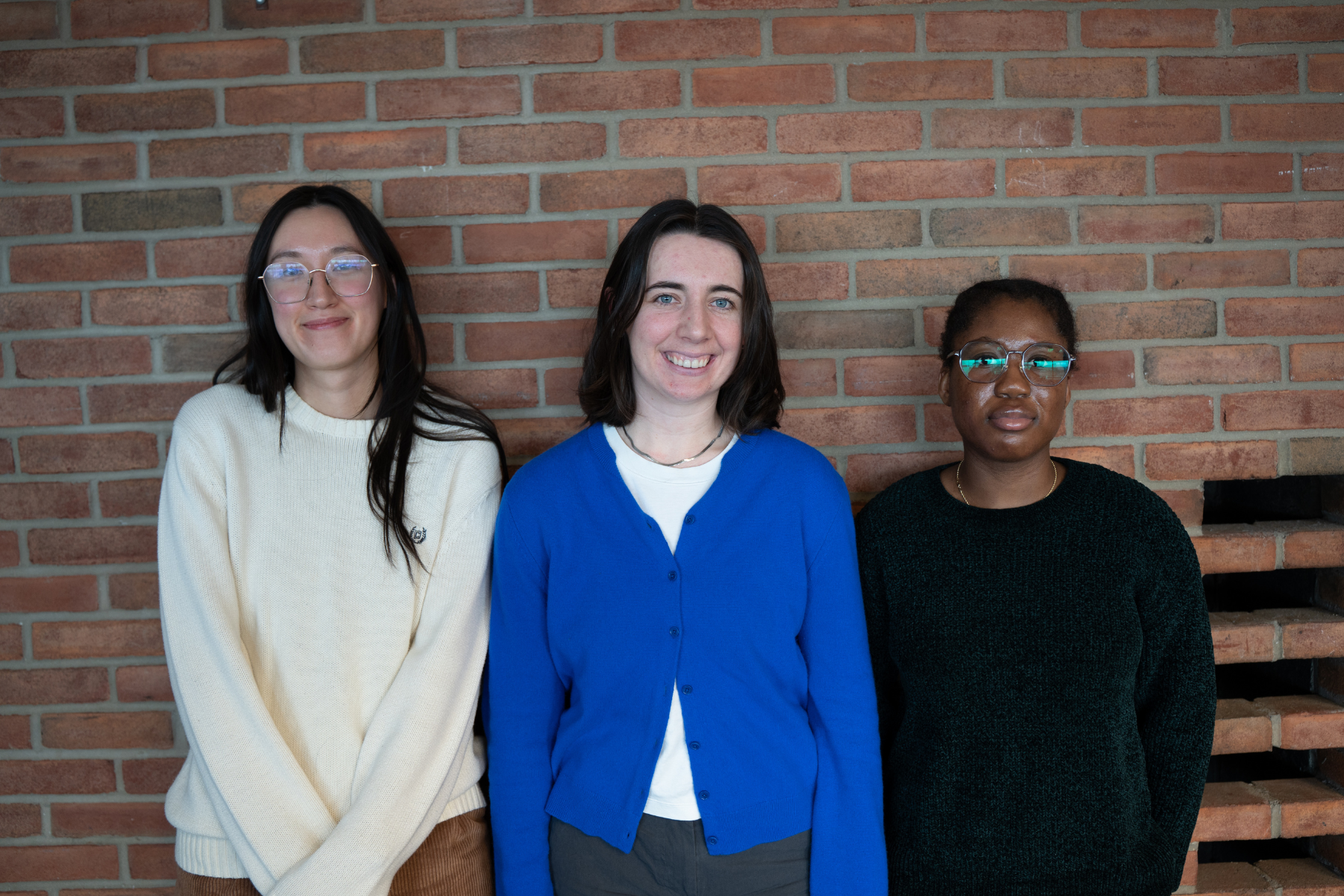
Members of 2023 Junior Professional Researcher cohort share what they learned during their time at ISR
February 27, 2026
ANN ARBOR — Three members of the Institute for Social Research’s (ISR) 2023 Junior Professional Researcher (JPR) cohort are sharing the knowledge and experience they gained through their time in the program.
Uma Hornish, Angelica Eagle, and Bolu Dogari met with current and future JPR students on Tuesday, February 17 to talk through what they learned as members of the JPR program, as well as how the JPR program prepared them for their current roles.
Hornish, now pursuing a graduate degree at the University of Michigan, arrived at the JPR program through her minor program. While in the program, she worked on research projects related to DNA methylation and dementia care. Hornish said she relished the opportunity to work independently at ISR, building a skill set that she anticipates will have a big impact on her future career as a genetic counselor.
“As a broad skill, learning independence and working on your own was really helpful to just get on to grad school and be an adult” she said. “I certainly appreciate the two years that I had here to develop that. My PI was really great, but also prioritized being able to do things on your own. As an undergrad, you can be reliant on doing what the professor tells you, but being able to be a self-starter and someone who can work independently, I found that very helpful in grad school.”
Eagle agreed, noting that her work at ISR in the JPR program boosted her confidence as a researcher, especially when it came to making key contacts with other researchers.
“When I was here, I had to do a lot of cold calling with people, and emails and things like that. And after doing that, now it’s no big deal,” she said. “I can just get in contact with whoever I need to on the phone. At first, that could be kind of scary to call people unannounced, but now it’s just not.”
Eagle worked on a number of research projects and subjects at ISR, specifically touching on topics related to aging and its biopsychosocial phenomena and social support for aging individuals. Now, she’s preparing to pursue a master’s degree this fall, and is currently working on research about and with post-career doctors.
Finally, Dolari ended up on a slightly different path, though one still bolstered by the JPR program. Now in a role as a senior research technician at the University of Michigan Transportation Research Institute (UMTRI), Dolaris says she benefitted from the de facto leadership training she received working in the ISR home lab and on virtual reality projects related to the Home Lab. The expertise she gained through that work positioned her well to hit the ground running at UMTRI, specifically in the parts of her role that relate to training others.
“I watched my mentor at Home Lab train people, and when I got to UMTRI we had new data collectors, and I had to do similar training,” she said. “Two full days of training. All of the organizing, making sure that everything was ready, making sure that people are actually learning what they need to learn, all of that came from watching people do it at ISR.”
And though they’ve ended up in a variety of different roles and career tracks after leaving the JPR program, all three agreed on the value of the program and what it provides to its participants.
For more information about past and future JPR cohorts and the program as a whole, click here.
Contact: Jon Meerdink ([email protected])